Tampilkan postingan dengan label spy thrilers. Tampilkan semua postingan

Minggu, 21 Agustus 2016

Code 7, Victim 5 (1964)

Given the title and the way it was promoted back in 1964 you could be forgiven for assuming that Code 7, Victim 5 is going to be yet another James Bond rip-off. Actually it’s a straightforward private eye yarn. It’s the South African setting that is the real highlight here.

This is one of the countless low-budget movies cranked out by writer-producer Harry Alan Towers. Towers liked making his movies in exotic locales - they gave a low-budget movie that touch of class and (even more importantly) they were usually ridiculously cheap filming locations.

South African mining magnate Wexler (Walter Rilla) is convinced someone is intending to kill him. Badly scared, he calls in American private eye Steve Martin (Lex Barker) even though he is already surrounded by a veritable army of security people.

Martin decides it might be wise to cooperate with the local police and Inspector Lean (Ronald Fraser) seems happy enough to go along with the idea.

The one clue that Martin has is a photograph take during the war. Wexler had been a German prisoner-of-war working on a prison farm in South Africa. There are four men in the photograph. One is now dead and one is under threat of death. Obviously it would be desirable to track down the other men in the photograph but that proves to be easier said than done.

Inspector Lean seems to be busily engaged chasing every young woman in Cape Town so Martin sets off with Wexler’s beautiful Danish secretary Helga (Ann Smyrner) to find the other two men. It soon becomes apparent that however is trying to kill Wexler would be quite happy to kill Martin as well.


The plot really is pretty routine. It’s the setting that makes things interesting. There’s a shootout in the world’s biggest subterranean cave system, there’s attempted murder on an ostrich farm (with the ostriches as the intended murder weapon) and there’s a decent climactic sequence on the slopes of Table Mountain. Most impressive of all is the opening murder sequence - a wonderful set-piece.

Robert Lynn directed a mere handful of films, spending most of his career in television. On the evidence of this movie, taking into account the very low budget he had to work with, he does pretty well. Of course it helps having the services of ace cinematographer Nicholas Roeg. 

Lex Barker is a perfectly adequate somewhat sardonic hero. Fine German character actor Walter Rilla makes Wexler a suitably enigmatic figure - a powerful man who obviously has some dark secrets. Ronald Fraser was always amusing although the idea of the entire female population of Cape Town being besotted by him does stretch credibility a very long way indeed!


Ann Smyrner as Helga and Véronique Vendell as Wexler’s adopted daughter Gina are there to add glamour which they do very successfully.

I have no idea why Blue Underground decided this film was worthy releasing on Blu-Ray. The anamorphic transfer (the film was shot in the Cinemascope ratio) is quite satisfactory  but probably would have looked just as good on a DVD. This movie is paired with another Harry Alan Towers production, Mozambique, on a single disc.

Code 7, Victim 5 is quite enjoyable on it own terms. It moves along quickly and it looks terrific. Recommended.

Kamis, 03 Maret 2016

The Day of the Jackal (1973)

The Day of the Jackal is a very different kind of 1970s action movie. This big-budget Anglo-French co-production might be unconventional but it’s also a very fine movie.

The end of the Algerian War and the granting of independence to Algeria by France’s President de Gaulle angered a lot of people within the French military. It angered them enough that they refused to accept this outcome. Disgruntled and embittered officers and ex-officers formed the Organisation de l'armée secrète (OAS) which carried out terrorist attacks and tried to assassinate de Gaulle. The movie opens with an extended action set-piece based on an actual OAS assassination attempt in 1962. 

The failure of this attempt was a major setback to the OAS. At this point fiction takes over. With their organisation riddled with police informers the surviving leadership of the OAS decides that their only hope is to employ an outsider, a professional hitman, to kill the President. This new attempt will be absolutely secret. Only the four top members of the organisation will know anything about it. The hitman they select is an Englishman, known by the code-name Jackal.

The Jackal (played by Edward Fox) is a very cool customer. He explains that after a job this big he will never be able to work again and therefore his fee will be extremely fee. Colonel Rodin (Eric Porter), the head of the OAS, agrees. The Jackal will work alone and will carry out the assassination at a time of his own choosing.


Much of the movie is concerned with the Jackal’s elaborate preparations - the procuring of false passports, the ordering of a very special gun, the careful planning that leaves nothing to chance. Running in parallel to this is the story of the efforts of the French security agencies (with assistance from Scotland Yard’s Special Branch) to track down the assassin.

The problem for the French is that de Gaulle refuses to take any special precautions or to cancel any public engagements and insists that the investigation be carried out in absolute secrecy. Inspector Lebel (Michael Lonsdale) is in charge of the case. Lebel has the reputation of being a brilliant detective who is also possessed of infinite patience. Slowly and painstakingly he begins the process of hunting the Jackal.


There are several things which make this movie an oddity in the genre. Apart from the opening sequence referred to earlier there is practically no actual action. The emphasis is on suspense. There is however a difficulty here - we know who the assassin is, we know what the crime will be, and we know the attempt will fail. We know that de Gaulle was not assassinated. Therefore the suspense must come from those things we don’t know - we don’t know how the assassination will fail and we don’t know how Lebel will catch the Jackal. In fact even though we know that de Gaulle will not be killed we can’t be sure the Jackal will be caught. We also don’t know exactly who the Jackal is - we know only his code-name.

In some ways this movie is an inverted mystery, where the interest comes from the manner in which the criminal is hunted down. It is also in some respects a police procedural with the focus on following the investigation in meticulous detail.


Kenneth Ross’s screenplay is quite faithful to the approach that Frederick Forsyth took in his excellent best-selling novel (which I warmly recommend). The wealth of detail could become tedious but in fact it’s fascinating.

Fred Zinnemann was a much-praised but somewhat overrated director but he does a splendid job here. This is a long film but while the pacing is unhurried the suspense is built very effectively.

Zinnemann chose Edward Fox to play the Jackal because he wanted an actor who seemed a different as possible from the stereotype of a hitman. It was an inspired choice. Fox plays the Jackal as an educated and cultured (and very polite) upper-class Englishman but he also succeeds in making him chillingly cold-blooded.

The support cast is exceptionally strong. Michael Lonsdale as Lebel provides a superb contrast to Fox’s Jackal - Lebel might be a superb detective but he is temperamentally a very ordinary policeman, and compared to the rather aristocratic Jackal he is something of a plebian. Lebel and the Jackal are worlds apart but both are in their very different ways thorough professionals who know their jobs very very well.


The movie is wonderfully evocative of the world of the early 1960s, a world that was already a vanished world when the movie was made in 1973.

The Region 2 DVD is widescreen but not 16x09 enhanced and has very little in the way of extras. On the other hand it can be picked up very inexpensively.

The Day of the Jackal might not please action movie fans who expect car chases and spectacular stunts. This is a more cerebral kind of thriller and a rather old-fashioned one. It is however a well-crafted piece of work and if you are prepared to accept it on its own terms it’s a tense and engrossing suspense film with a great lead performance by the under-appreciated Edward Fox. Highly recommended.

Minggu, 10 Januari 2016

So Darling, So Deadly (1966)

So Darling, So Deadly (AKA Agent Joe Walker: Operation Far East, original title Kommissar X - In den Klauen des goldenen Drachen) was the third of the seven popular Kommissar X eurospy films. It’s an international co-production between Germany, Italy, Austria and Singapore. This is a fairly typical eurospy feature and it’s one of the better examples of the breed.

Joe Walker was the hero of a series of German crime/espionage novels. Paul Alfred Mueller wrote 620 (!) Kommissar X novels under the name Bert F. Island - and there were hundreds more titles by other writers.  

The eurospy genre of course consisted of low-budget James Bond knock-offs but the best of them have a distinctive flavour, and a madness, all their own.

One thing you don’t worry too much about in eurospy movies is plot coherence. They do have plots but if the plots make no sense that tends to be a feature rather than a bug. This one has a plot and it concerns a kindly well-intentioned physicist who has invented a new kind of laser that is a terrifying death ray. It’s remarkable how many kindly movie scientists seem to devote their careers to the invention of death rays. This particular death ray can knock an aircraft out of the sky 300 miles away.

Of course like every brilliant scientist in the history of movies he has a beautiful daughter, and of course you know that at some point she’s going to get herself kidnapped by the bad guys.

Agent Joe Walker (Tony Kendall) is given the task of preventing the death ray from falling into the wrong hands. In the novels Joe Walker was apparently a kind of private eye but in this movie he seems to work (possibly unofficially) for a agency known as the International Bureau. He is sent to Singapore to protect the scientist and he is accompanied by tough New York cop Captain Tom Rowland (Brad Harris).


A mysterious group of bad guys try to kill Walker and Rowland as soon as their plane lands in Singapore and they go on trying to kill them. The bad guys include a deadly blonde named Stella (Gisela Hahn) who seems to see killing as her vocation in life.

There’s no point in worrying too much about what happens next. Suffice to say there are murders, lots of attempted murders, kidnappings, brawls and in general plenty of action. The death ray is basically a McGuffin and it provides the excise for mayhem in abundance. Since it’s set in Singapore there’s a certain flavour of the Mysterious East to it and there are even a few hints of Fu Manchu in the form of the brotherhood of the Golden Dragon.


Writer-director Gianfranco Parolini made peplums, spaghetti westerns and eurospy movies and with So Darling, So Deadly he proves himself to be fairly competent. He keeps the action moving along at a frenetic pace and he handles the action scenes well enough considering the budgetary restraints he was working under. Much of the movie was shot in Singapore, giving the obligatory touch of the exotic. The action scenes obviously can’t compare to those in a Bond film but they’re executed with a reasonable amount of flair. The Singapore locations are used quite effectively.

Tony Kendall, despite his name, was an Italian actor. He makes a perfect eurospy hero - suave, dashing, recklessly brave, always chasing the ladies and always with tongue planted firmly in cheek. He may not have been the world’s greatest actor (although he’s perfectly adequate) but most importantly he was handsome and he certainly had charm and charisma, he could do action stuff convincingly and he looked like a movie secret agent.


Brad Harris was a genuine American, a college athlete and bodybuilder who made a career for himself in the Italian movie industry appearing in peplums, spaghetti westerns and eurospy films. He makes a good foil for Tony Kendall. In the discotheque scene he proves himself to be an amazing dancer - and I don’t mean that in a good way.

Do you remember the bad old days of VHS when if you wanted to watch a movie at home you would find yourself watching a horrible mangled pan-and-scanned print, probably cut, and with atrocious picture quality? Those bad old days are gone forever. Unless you’re a eurospy fan If you’re a eurospy fan then the only way to see most of your favourite titles is still in horrible cut pan-and-scanned prints with abysmal picture quality. 


Retromedia’s DVD release of the first three Kommissar X movies being a case in point. So Darling, So Deadly is indeed pan-and-scanned and image quality is fairly bad. The colours are a bit washed out and they vary wildly from scene to scene. To be fair this seems to improve as the movie progresses. This really is not a great transfer.

On the other hand if you are a eurospy fan you know that this is, with a very few exceptions, par for the course. If you want to see these movies you just have to put up with outrageously awful transfers. And sometimes it’s worth it. This is one of those times when it really is worth it.

The frustrating thing about being a eurospy fan is that you know that one of the reasons the genre is not highly thought of is simply that most people have never had the opportunity to see these movies in their correct aspect rations and in decent prints.

So Darling, So Deadly is classic eurospy fun. It’s silly fast-paced action-packed enjoyment. Highly recommended.

Sabtu, 15 Agustus 2015

The Liquidator (1965)

The Liquidator is yet another 1960s spy spoof movie, this one being a British production. The problem with spy spoofs was to get the tone right. The Matt Helm and Derek Flint movies were straight-out spoofs which worked pretty well. Another equally valid option was to take the slightly tongue-in-cheek flavour of the Bond movies and push things just a little further.

The Liquidator shows what happens when the tone isn’t quite right. It’s not sure if it wants to aim for slapstick or sophisticated banter and at times it seems to be tempted to take a more serious line. The Bond movies managed to combine the tongue-in-cheek approach with decent spy movie plots and plenty of spectacular action. The Liquidator just doesn’t have enough action to succeed on that level. It’s still fairly entertaining although it has to be counted as more of a near miss than an actual hit.

The basic premise really would have lent itself very well to a black comedy approach but this avenue is never really explored.

During the war Sergeant Boysie Oakes (Rod Taylor) had saved the life of British intelligence agent Major Mostyn (Trevor Howard). Flash forward twenty years and Major Mostyn is now Colonel Mostyn, a senior officer in the Security Organisation. Colonel Mostyn and his boss (played by Wilfred Hyde-White) have a problem. There have been so many security leaks and so many spy scandals that their jobs are on the line. They have a rough idea who the potential security risks are but they can’t do anything until they have actual evidence and by that time it’s too late - there’s yet another spy scandal for the press to make a fuss about. That’s the trouble with being the good guys - you have to worry about annoying details like evidence and the legal rights of suspects. It would be so much easier just to have all the potential security risks killed quietly and without fuss. In fact the more the Chief and Colonel Mostyn think about it the better that idea sounds. Why not employ someone to do just that? Unofficially of course.


Mostyn now remembers that young tank sergeant who saved his life during the war. He does a bit of digging into the past of Boysie Oakes and he likes what he discovers. Quite a few of Boysie’s more irritating and inconvenient acquaintances seem to have met with fatal accidents. Colonel Mostyn draws the obvious conclusion - that Oakes is a cold-blooded and efficient murderer and is therefore just the man he’s looking for. He recruits Oakes as an ultra top secret assassin.

There’s only one problem. Boysie is not a cold-blooded killer. He’s a good-natured but rather clumsy fellow, so clumsy that he may well have been responsible for a few accidents, but Boysie is incapable of hurting a fly intentionally. Boysie doesn’t point out Mostyn’s error because he has no idea what he has actually been recruited to do until it’s too late.


Boysie is now a secret agent. He’s been set up in a luxury London flat, provided with a sleek sports car, he’s getting paid lots of money and it seems like a job that involves very little actual work. This should provide plenty of free time for Boysie to do the only thing he’s really good at - chasing women. It all seems like splendid fun. Until he discovers that his job is to kill people. That’s one thing Boysie just cannot do. It’s an awkward situation but Boysie discovers a solution - he pays a professional hitman to do the killing for him.

Of course we know that eventually Boysie will find himself having to play secret agent for real. And we know that he’s likely to get himself in a good deal of trouble.


Rod Taylor is reasonably well cast. He has the slightly bumbling amiability that the role demands. Trevor Howard is as reliable as ever. Jill St John is fine as Mostyn’s secretary (and the object of Boysie’s lust). Eric Sykes was one of the great English comedians but he was also quite capable in straight dramatic roles and he does very well as hitman Griffen. He’s the most interesting character in the film and should have been given a lot more screen time. What stands out about the supporting cast is that it’s composed overwhelmingly of great character actors who were particularly good at comedy - actors like John le Mesurier, Derek Nimmo, Eric Sykes and David Tomlinson. And yet they’re given remarkably few opportunities to display those gifts.

Peter Yeldham’s screenplay certainly seems to be the weak link here. 

The movie was directed by Jack Cardiff, a superlative cinematographer who directed a handful of features including Dark of the Sun (in which Rod Taylor gives his career-best performance). Cardiff’s movies always look good and this is no exception. One can’t help feeling though that maybe Cardiff wasn’t the right choice for a spy spoof.


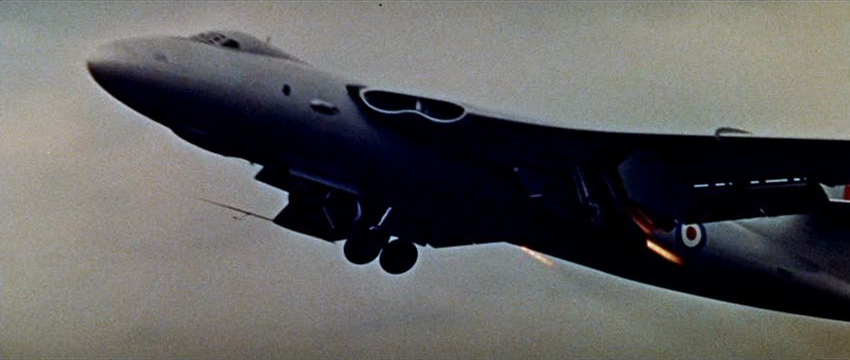
Aviation geeks will be excited by the prominent part played by a very cool Vickers Valiant bomber.

The Warner Archive made-on-demand DVD offers a generally good anamorphic transfer.

The Liquidator is harmless and reasonably enjoyable but with less sexual innuendo and more black comedy it could have been considerably better. Worth a look for hardcore spy spoof fans and spy movie completists.

Selasa, 07 Juli 2015

Our Man in Marrakesh (1966)


Our Man in Marrakesh (also released under the title Bang! Bang! You're Dead!) is a low-key spy spoof from prolific producer Harry Alan Towers whose spectacularly uneven output   embraced just about every exploitation genre one can think of. This particular production can best be described as innocuous but fairly entertaining.

Mr Casimir (Herbert Lom) is a spymaster anxiously awaiting a courier bringing two million dollars to buy some sensitive documents that he’s obtained by presumably rather nefarious methods. He knows the courier is one of six people catching a bus from Marrakesh but unfortunately he has no idea which one is the courier. Compounding the problem is that not one of the six people is what he appears to be.

Andrew Jessel (Tony Randall) has come to Marrakesh to build a hotel but he’s masquerading as an oilman. Krya Stanovy (Senta Berger) has half a dozen explanations for her presence in Morocco, none of them true. Mr Fairbrother (Wilfred Hyde-White) claims to be selling bathroom fittings while Mr Lillywhite (John le Mesurier) claims to be a promoter of package tours.

Jessel and Krya are thrown together when a dead body is found in Jessel’s hotel room. They have the police after them and Casimir’s men as well, led by the sinister Jonquil (Klaus Kinski). After being chased over half of Morocco they encounter an unlikely chieftain of a band of Arab bandits - the Eton-educated Al Caid (Terry-Thomas).


The plot is not exactly strong on originality but it doesn’t really matter. Don Sharp’s typically energetic direction ensures that the action doesn’t flag. And there is quite a bit of action.

This movie’s biggest asset is the delightful cast. Tony Randall might be an unlikely hero for a spy movie but this is hardly a serious spy movie and in any case Andrew Jessel is the archetypal innocent caught up in a web of espionage that he finds utterly bewildering and Randall has no difficulty playing that sort of character. In fact he’s rather good.


Senta Berger manages to be slightly ditzy, glamorous, mysterious and appealing which is exactly what her rôle calls for. Herbert Lom oozes smooth sinister charm in the inimitable Herbert Lom manner. Klaus Kinski was always well cast as a colourful heavy while Margaret Lee is fun as Casimir’s dotty girlfriend. John le Mesurier and Wilfred Hyde-White are wonderful as ever while Terry-Thomas sparkles as the old Etonian brigand leader. It’s a superb cast perfectly suited to the material.

While it was the Bond films that caused the 60s spy movie craze Our Man in Marrakesh is not, unlike the Derek Flint movies (such as Our Man Flint) or the Matt Helm movies (such as The Wrecking Crew), a spoof of the Bond movies. It’s a spoof of an earlier generation of spy movies - movies like Hitchcock’s North by Northwest - which typically featured an ordinary guy who gets mixed up in espionage very much against his will.


Don Sharp was a logical choice to direct. He could always get good results on a limited budget and he was more than competent when it came to action scenes (and this one includes a couple of pretty decent action set-pieces).

The location shooting in Morocco certainly paid off, giving the movie the ideal atmosphere of intrigue in exotic locales.

While this is a spoof it’s a gentle kind of spoof. Don’t expect the outlandishness of a Matt Helm movie. This is a much more low-key sort of movie. There’s plenty of amusement to be had but then it throws in a moderately serious spy movie climax with a bit of real excitement. 


This DVD is typical of Network’s releases - a good anamorphic transfer, no extras, and fairly reasonably priced.

Our Man in Marrakesh is the sort of movie that could never be made today. It’s innocent gently tongue-in-cheek good-natured fun with zero social comment and zero irony, absolutely no graphic violence and barely a hint of sex. It aims to do nothing more than deliver light-hearted entertainment and it succeeds admirably. It also has a simply wonderful cast. Highly recommended.

Minggu, 14 Juni 2015

Innocent Bystanders (1972)

By 1972 when Innocent Bystanders was released the spy movie craze had pretty well peaked. There would still be spy movies of course and some would do very well but the days when a modestly budget spy thriller was a guaranteed money-spinner were over. So it’s not altogether surprising that Innocent Bystanders has disappeared into almost total obscurity. Which is a pity because it’s not a bad movie at all.

Stanley Baker plays John Craig, a British agent who works for the ultra-secret Department K (which handles assignments that are too grubby for any other intelligence agency to touch).

The problem is that Craig is washed up. He’s middle-aged, weary and disillusioned, his previous assignment ended badly and there is considerable doubt as to whether he has fully recovered from a particularly brutal session of torture courtesy of the KGB. The head of Department K, Loomis (Donald Pleasence), gives Craig one last chance to prove he still has what it takes.

The basic premise is set up for us with a well-staged and very violent prison break from a Soviet Gulag. One of the escapees was an agronomist named Aaron Kaplan (Vladek Sheybal). Now the CIA has decided it wants Kaplan. The problem for the head of the CIA’s Group 3, Blake (Dana Andrews), is that there’s a leak in his section. So he wants the British to get Kaplan for him. Loomis is happy to do this, for a price. It’s a price the Americans are not prepared to pay but Loomis decides it might be advantageous to get Kaplan anyway. This will be Craig’s chance to redeem himself.


Craig will have the assistance of two other Department K agents, Royce (Derren Nesbitt) and Benson (Sue Lloyd). He doesn’t want their help, and with good reason. They’re young hotshot agents. Craig had been Department K’s top agent and they would both like to supplant him.

The mission takes Craig to New York, and then to Turkey. The KGB are also after Kaplan but Craig finds the Americans to be a bigger problem. To get to Kaplan he has to get to Kaplan’s brother in New York and to make things easier (as he imagines) he kidnaps the brother’s ward Miriam Loman (Geraldine Chaplin). Miriam doesn’t seem too bothered about being kidnapped. In fact she seems to be quite pleased to be kidnapped by a big strong macho British spy.

Of course this being a spy thriller there are going to be double-crosses. Lots of them.


This movie is a far cry from the Bond movies. There’s not a huge amount of action but there’s quite a bit of violence and this being the early 70s the violence is often quite graphic. There are no gadgets, no spectacular stunts, no large-scale action set-pieces. The budget wouldn’t have stretched that far but this is in any case not that kind of spy thriller. This movie is very much in the gritty realist mode. That’s not surprising given that it was scripted by James Mitchell from one of his own novels and Mitchell was the creator of the archetypal British cynical gritty realist TV spy drama Callan. Innocent Bystanders has more in common with Callan (and with the 1974 Callan movie) than with Bond, with the ageing violent disillusioned hero (almost an anti-hero), the vicious young hotshot agent who wants his job, the duplicitous and callous spymaster and the general tone of pessimism and betrayal.

Stanley Baker makes a fine tough, ruthless but psychologically damaged hero. Geraldine Chaplin was an odd choice for a leading lady in a spy thriller but her slightly offbeat performance works quite well - she’s no Bond girl but this is not a Bond movie.


A major bonus is the superb supporting cast. Donald Pleasence is chillingly reptilian. Dana Andrews can’t quite match him for cold calculating creepiness but he gives it his best shot and he’s very effective. The very underrated Derren Nesbitt (best known as the star of the superb British cop/espionage TV drama series Special Branch) is delightfully vicious. Sue Lloyd does well as the female spy Benson. What you don’t quite expect in a film written by James Mitchell is comic relief but that’s exactly what Warren Mitchell provides in a deliciously outrageous turn as Omar, a Turk with an Australian accent who becomes an unlikely ally for Craig.

Director Peter Collinson had a brief but interesting career before his untimely death at the age of 44. His best-known feature was The Italian Job and he brings a similar kind of quirkiness to Innocent Bystanders.


The Olive Films DVD is what we’ve come to expect from this company - slightly overpriced, totally bereft of extras but a satisfactory transfer of an obscure and hitherto impossible-to-find movie.

Innocent Bystanders never really had a chance in 1972. It just didn’t have the budget to compete with blockbuster spy movies such as the Bond movies. Spy fans prepared to accept it on its own terms will however find much to enjoy here. Recommended.

Selasa, 26 Mei 2015

Callan (1974)

The television series Callan was a sensation when it first started screening in Britain in 1967. The public loved it and the critics loved it just as much. It is still widely regarded as the finest television spy drama series ever made. Callan ran until the early 70s and in 1974 a feature film followed.

Despite its popularity this was a series that was going to be tricky to do as a movie. Much of the success of the series was due to its brooding claustrophobic atmosphere. Obviously it had to be opened up a bit for a movie release and it was going to need a bit more action. In fact the movie works quite well. Even though it has a car chase (something quite unthinkable in the TV version) it still retains much of the necessary stifling atmosphere.

The other big problem was casting. Fortunately Edward Woodward and Russell Hunter were available and they were the two actors who would have utterly irreplaceable. On the other hand the key roles of Hunter and Meres had to be recast, with mixed success.

The movie is an expanded version of the original pilot episode, A Magnum for Schneider,  screened as part of Thames TV’s Armchair Theatre in 1967.

David Callan (Edward Woodward) was the top agent for a branch of the British security services known only as The Section. He has been more or less pensioned off. This is partly due to his drinking but mostly because as a counter-spy he has one very serious flaw - he has a conscience. That’s a problem because of the specialised nature of The Section’s activities. Their job is to get rid of people who are considered to be so dangerous that extreme measures are justified. These measures can include blackmail or intimidation but they can also involve assassination. Callan was The Section’s top assassin. An assassin with a conscience is however more a liability than an asset.


Now the head of The Section, Hunter (Eric Porter), has decided he wants Callan back. He needs him for a particularly tricky assignment. But can Callan be trusted? And can Callan trust Hunter?

Adding to the tenseness of the situation is that Callan again finds himself working with The Section’s number two agent, Toby Meres (Peter Egan). There are a whole series of reasons why Callan and Meres should dislike working together. Callan has a conscience, something that Meres conspicuously lacks. Meres is ambitious and wants Callan’s job as the top agent. Callan is working class, Meres is distinctly upper class. Meres also happens to be a cold-blooded sadist.

Callan will also need the assistance of his disreputable friend Lonely. Lonely is an outcast and he smells bad but he does possess certain talents - he is a skilled burglar and there is nobody better at tailing people without being seen than Lonely.


Callan’s target is Schneider, a successful German-born businessman in the export-import trade. Callan has no idea why Hunter wants Schneider dead and although it is strictly against orders he is determined to find out. What exactly is it that Schneider imports and exports?

Schneider shares Callan’s passion for wargaming and that proves to be a very useful way of making contact. It’s also a way for the two men to test each other out.


Edward Woodward is superb as always as Callan. Russell Hunter is equally good as Lonely. Carl Möhner as Schneider and Catherine Schell as his wife are both fine. Eric Porter makes a good Hunter, charming but ruthless. The problem is Peter Egan as Meres. Actually the real problem is that Anthony Valentine was so superb in this role in the TV series that nobody else was likely to match his performance. Valentine added so many nuances to the part and he had a gift for sardonic humour that made the character both more human and more inhuman. Peter Egan just isn’t in the same class and as a result his  Toby Meres is a mere sadistic thug. This is a pity since the interplay between Callan and Meres had been one of the highlights of the TV series.

Don Sharp was a very competent action thriller director. The TV series had been intensely character-driven with action and violence used sparingly but effectively. The movie had to have more action but Sharp still retains the essential feel of the series and its focus on character.


Umbrella Entertainment’s Region 4 DVD release offers a reasonably decent if not brilliant transfer and it includes a rather good interview with star Woodward.

This movie version is more successful than might have been anticipated. It’s not quite as strong as the Callan TV series but it’s still a fine spy thriller very much in the gritty realist mode, with plenty of cynicism and moral ambiguity. Highly recommended.

Jumat, 08 Mei 2015

A Dandy in Aspic (1968)

Spy movies were all the rage in the 1960s. In tone they ranged from dark, brooding and tragic all the way to outrageous light-hearted silliness. It was the success of the first Bond film, Dr No, in 1962 that really kicked the spy genre into high gear and established the essential truth that whatever the mood a spy film needed to be stylish. Of course Hitchcock  had already been making stylish spy movies for years and at the tail end of the 50s had had one of his biggest hits with North by Northwest but after Dr No spy movies became a positive craze. A Dandy in Aspic was Anthony Mann’s first attempt at the genre and it would prove to be his last film.

Alexander Eberlin (Laurence Harvey) is a British spy. Only he isn’t really Alexander Eberlin. His real name is Krasnevin and he is actually a Soviet spy. He’s a double agent but his loyalty is to the Russians, not surprising since he is a Russian. Now the British have handed him a rather awkward assignment. They want him to kill a top Russian agent, a chap by the name of Krasnevin. He himself is the man he has been ordered to kill.

It’s actually even more complicated than that. The British of course don’t know that Eberlin is Krasnevin. 

Eberlin/Krasnevin’s impossible task is made even more impossible when Gatiss (Tom Courtenay) is assigned to help him on this mission. He hates Gatiss and the feeling is mutual. Gatiss is cold-blooded and very very efficient. He enjoys killing.


To make a difficult situation even worse Eberlin/Krasnevin has met a bright, breezy and rather eccentric English girl named Caroline (Mia Farrow). The last thing he needs right now is a romantic entanglement but that’s what he’s going to get. Caroline has no idea what she is getting involved in although she’s crazy enough that she probably wouldn’t care anyway.

An even bigger problem for Eberlin/Krasnevin is that he wants to go home. Home to Russia. He is tired of being a spy, tired of having no real identity, tired of deception and tired of killing. He is a Russian and Russia is home. The Russians however do not want him to come home - he is too valuable to them where he is. When he is sent to West Berlin he thinks his opportunity has come. Everyone else is trying to escape from East Berlin. He is trying to escape to East Berlin.


Sadly Anthony Mann died during the making of the film. Laurence Harvey took over as director (having already had some experience as a director). Harvey stated at the time that his aim was to complete the film in Mann’s style without intruding any of his own style into it. It’s difficult to say how completely he succeeded since the movie was in any case a radical departure from Mann’s own previous style.

The film was not well received at the time and is generally dismissed as an unfortunate end to the career of a great director. It is a quirky film but quirky spy movies tended to do very well in the 60s. A Dandy in Aspic bears little resemblance to the Bond movies, belonging more to the dark and brooding school of spy film-making. Dark and brooding, but very stylish. In that respect it’s not dissimilar to the Harry Palmer movies such as The Ipcress File. Given that The Ipcress File did pretty well and has since gained a major cult following it’s difficult to understand why A Dandy in Aspic failed and has languished in obscurity ever since.


There’s not a great deal of action but other character and atmosphere-driven spy thrillers were successful at that time.

The film’s failure cannot be attributed to the cast. Laurence Harvey is perfect for the role of the embittered and desperate double agent. It’s a very low-key performance but given that he’s playing a man with no coherent sense of identity that works quite well. It also helps in not making the character too sympathetic - he is after a ruthless spy and a pitiless assassin. Tom Courtenay is surprisingly chilling as the ice-cold Gatiss, and manages to make him more than just a killing machine. We get a sense that he does have emotions but they’re well and truly buried and they’re seething away somewhere deep inside him. Mia Farrow is ditzy but appealing. The strong supporting cast includes such fine British character actors as Harry Andrews, Geoffrey Bayldon and Norman Bird. Look out for comic Peter Cook as a lecherous British spy.


Derek Marlowe’s screenplay was adapted from his own novel. It has plenty of twists and turns and plenty of the kind of cynicism that went down so well in the 60s. Having a Russian spy as the hero was an interesting twist. 

Sony’s Region 2 DVD release offers an extremely good anamorphic transfer.

A Dandy in Aspic is a tense stylish spy thriller which deserves to be rediscovered. Highly recommended.